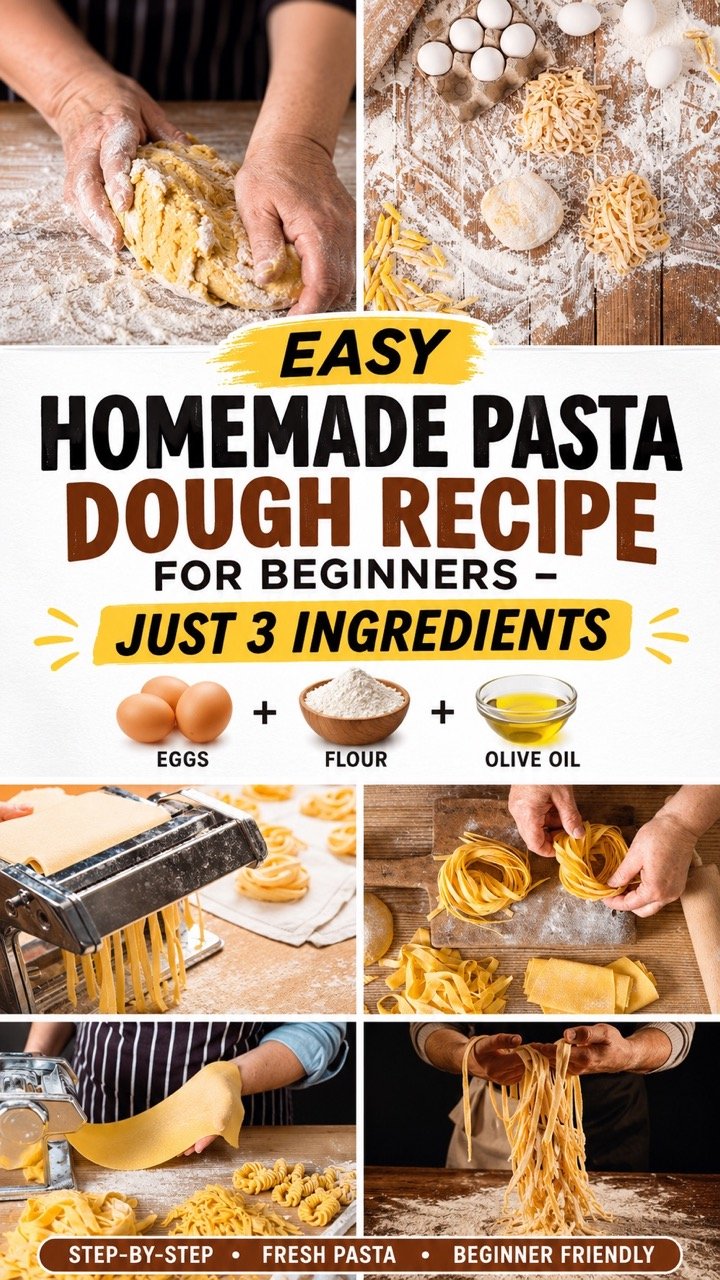
HOW TO MAKE HOMEMADE PASTA DOUGH (BEGINNER’S GUIDE)
Learn how to make homemade pasta dough from scratch with just flour and eggs.
This beginner’s guide covers the basic recipe, kneading, rolling, 9 easy pasta shapes, flavored doughs, and how to store, dry and freeze fresh pasta.
Homemade pasta dough only needs two ingredients, flour and eggs, and it tastes completely different from the dried stuff in a box. It’s silky, tender and cooks in about 3 minutes.
Once you’ve made it a couple of times, you’ll wonder why you waited so long (and if you already love making dough from scratch, try our homemade potato gnocchi next).
Fair warning: your first batch might not look perfect. That’s okay. It will still taste better than store-bought.
Related Articles
- Homemade Potato Gnocchi Recipe
- Homemade Sweet Potato Gnocchi
- Spaghetti with Olive Oil and Garlic Sauce (Pasta Aglio E Olio)
- Creamy Garlic White Pasta Sauce
- Spinach Lasagna with Ricotta and Feta
🛒 5 Must-Haves for Making Fresh Pasta at Home
These are the tools that make homemade pasta easier, faster and a lot more fun, especially when you’re just starting out.
- Manual Pasta Machine: Rolls dough evenly thin and cuts fettuccine and spaghetti in seconds.
- Bench Scraper: Folds dough, cleans the counter and portions dough without sticking.
- Pasta Drying Rack: Hangs long noodles so they dry without clumping.
- KitchenAid Pasta Roller and Cutter Set: Turns your stand mixer into a pasta machine that rolls and cuts hands-free.
- Tipo 00 Pasta Flour: Extra fine flour that makes the silkiest, smoothest pasta dough.
As an Amazon Associate I earn from qualifying purchases.
📋 Quick Recipe Facts
Ingredients: 2 cups flour, 3 eggs, salt (oil optional)
Hands-on time: about 30 minutes
Resting time: 30 minutes
Cook time: 2 to 4 minutes
Makes: about 1 lb fresh pasta, 3 to 4 servings
Skill level: beginner friendly
🥚 The Golden Pasta Ratio
Use 1 large egg for every 100g (about 3/4 cup) of flour. That’s roughly one serving per egg, so it’s easy to scale: 2 eggs for 2 people, 4 eggs for 4 people. Weighing the flour gives the most consistent dough.
⚠️ Biggest Beginner Mistakes
Skipping the rest (the dough will fight you and shrink back). Adding too much flour while kneading (it makes the pasta tough). Rolling too thick (fresh pasta should be thin enough to see your hand through for most shapes). Dusting with flour instead of semolina (cut noodles stick together).
⏱️ Make-Ahead Friendly
Make the dough up to 1 day ahead and keep it wrapped in the fridge. Let it sit at room temperature for 20 minutes before rolling. Shaped pasta can be frozen for up to 1 month and cooked straight from frozen.
What You Need to Make Homemade Pasta
The basic recipe is just flour, eggs and a pinch of salt. The type of flour changes the texture, so here’s a quick guide before you start.
🌾 Which Flour Is Best for Pasta Dough?
| Flour | Texture | Best For |
|---|---|---|
| 00 flour | Silky, smooth and tender | Fettuccine, ravioli, tortellini, lasagna |
| All-purpose flour | Slightly chewier, very forgiving | Any egg pasta, great for beginners |
| Semolina (durum wheat) | Firm, chewy, holds its shape | Eggless pasta, orecchiette, cavatelli |
| Half 00, half semolina | Tender with a little bite | Pappardelle, tagliatelle, farfalle |
| Whole wheat flour | Nutty and hearty | Long noodles with rich sauces |
Equipment
- Must have: a clean counter or large board, a fork, a rolling pin, a sharp knife and plastic wrap.
- Very helpful: a bench scraper and a kitchen scale.
- Nice to have: a pasta machine, a pasta drying rack, a ravioli stamp and a fluted pastry wheel.
Basic Homemade Pasta Dough Recipe
This is the classic Italian egg pasta dough made with the well method. You’ll find the full recipe card at the bottom of the post.
 Print
Ingredients
2 cups (250g) 00 flour or all-purpose flour, plus more for dusting
3 large eggs, room temperature
1 tbsp olive oil (optional)
1/2 tsp fine salt
1 to 2 tbsp water, only if needed
Step-by-Step: How to Make Pasta Dough by Hand
Don’t rush the kneading. The dough changes from rough and dry to smooth and silky, and that’s when you know it’s ready.
Directions
- Pour the flour onto a clean counter or a large wooden board and mix in the salt with your fingers.
Shape it into a mound, then use your fingers to make a wide, deep well in the center, about 4 inches across.
Make the walls high enough that the eggs won’t escape (this is the part most beginners worry about, and it’s fine if a little leaks). - Crack the eggs into the well and add the olive oil if you’re using it.
Beat the eggs gently with a fork, keeping the fork inside the well.
Start pulling a little flour from the inside walls into the eggs as you whisk. - Keep whisking and pulling in flour until the center turns into a thick, shaggy paste that’s too stiff for the fork.
Use a bench scraper to fold the rest of the flour over the paste.
Press and gather everything into a rough ball. It will look dry and messy at this point, which is normal. - Knead the dough for 8 to 10 minutes. Push it away with the heel of your hand, fold it back over itself, turn it a quarter turn and repeat.
If it feels too dry and won’t come together after 3 minutes, wet your hands and keep kneading, or add water a teaspoon at a time.
If it sticks to your hands, dust with a little flour. The dough is ready when it’s smooth, firm and springs back slowly when you press it. - Wrap the dough tightly in plastic wrap or cover with an upside-down bowl.
Rest it at room temperature for 30 minutes, or up to 2 hours.
Resting relaxes the gluten so the dough rolls out thin without shrinking back. - Cut the dough into 4 pieces and keep the ones you’re not using covered so they don’t dry out.
Flatten one piece into a small rectangle and roll it out with a pasta machine or rolling pin (see the rolling guide below).
Cut or shape it into your favorite pasta, dust well with semolina or flour, and cook right away or store it.
Other Ways to Mix Pasta Dough
- Food processor: pulse the flour and salt, add the eggs and pulse until it looks like coarse crumbs that clump when pinched. Tip it out and knead for 3 to 4 minutes.
- Stand mixer (like a KitchenAid): mix with the flat beater on low until combined, switch to the dough hook and knead on speed 2 for 6 to 8 minutes. Full KitchenAid steps are below.
- In a bowl: if the well method feels messy, make the well in a large bowl instead. Same steps, less cleanup.
How to Tell When Your Pasta Dough Is Ready
| What You See | What It Means | What to Do |
|---|---|---|
| Crumbly, won’t hold together | Too dry | Knead with wet hands or add water 1 tsp at a time |
| Sticks to your hands and board | Too wet | Dust with flour 1 tbsp at a time and keep kneading |
| Lumpy, rough surface | Not kneaded enough | Keep kneading another 3 to 5 minutes |
| Smooth, firm, springs back slowly | Ready | Wrap it and let it rest |
How to Roll Out Pasta Dough
With a Pasta Machine
Flatten a piece of dough and run it through the widest setting. Fold it in thirds like a letter and run it through again 2 or 3 times to make it smooth and even.
Then pass it through each setting once, getting thinner each time, until you reach the thickness you need. Dust lightly with flour if it starts to stick.
📏 Pasta Thickness Guide
| Pasta | Manual Machine (1 to 9) | KitchenAid Roller (1 to 8) | Thickness |
|---|---|---|---|
| Pappardelle, tagliatelle, fettuccine | 5 to 6 | 4 to 5 | About 1mm |
| Lasagna sheets | 5 to 6 | 4 to 5 | About 1mm |
| Spaghetti, linguine (cutter) | 5 | 4 | About 1.2mm |
| Ravioli, tortellini | 6 to 7 | 6 | Thin enough to see your hand through |
| Farfalle, garganelli | 5 | 4 to 5 | About 1mm |
Settings vary a little by brand, so roll a test strip first. If it tears, go back one setting.
How to Make Homemade Pasta with a KitchenAid
A KitchenAid stand mixer can do almost all the work here: mixing, kneading, rolling and cutting. It’s the easiest way to make a big batch, and your arms will thank you.
🔌 KitchenAid Pasta Attachments
Pasta Roller: rolls sheets from setting 1 (thickest) to 8 (thinnest).
Fettuccine and Spaghetti Cutters: slice rolled sheets into noodles.
Pasta Press: pushes stiff dough through plates to make rigatoni, fusilli, bucatini, macaroni and spaghetti, with no rolling needed.
Ravioli Maker: fills and seals ravioli from two sheets at once.
Step 1: Mix and Knead the Dough
- Add the flour and salt to the mixer bowl.
- Attach the flat beater, add the eggs and oil, and mix on speed 2 for about 1 minute until crumbly.
- Switch to the dough hook and knead on speed 2 for 6 to 8 minutes until smooth and elastic.
- If it stays crumbly, add water 1 tsp at a time. Finish with 1 minute of kneading by hand, then wrap and rest 30 minutes.
Step 2: Roll With the Pasta Roller
- Attach the roller and set it to 1. Turn the mixer to speed 2.
- Flatten a quarter of the dough and feed it through. Fold it in thirds and pass it through setting 1 two more times.
- Feed it once through each setting (2, 3, 4 and so on) until you reach the thickness in the chart above.
- Dust with flour if it gets sticky, and support the sheet with your hand as it comes out.
Step 3: Cut or Press Your Pasta
- Swap the roller for the fettuccine or spaghetti cutter, keep the mixer on speed 2 and feed the sheet through.
- Catch the noodles as they come out, toss with semolina and twist into nests.
- For tube and spiral shapes, use the pasta press with a stiffer dough (use 1 less egg yolk or 2 tbsp extra flour) and cut the shapes to length as they come out.
Honestly, the first sheet through the roller is usually a little uneven. Fold it up and run it through again and the next ones come out perfect.
With a Rolling Pin
No machine? No problem. Roll from the center outward, giving the dough a quarter turn every few rolls so it stays round and even.
Keep going until it’s thin enough that you can just see the pattern of your counter through it. It takes some arm work (and a little patience), but it’s how pasta was made for centuries.
Pasta Shapes You Can Make From One Dough
One batch of dough can become almost any shape. Here are the easiest ones for beginners, from simple ribbons to filled pasta.
1. Fettuccine and Tagliatelle
The easiest shapes to start with. Fettuccine is about 1/4 inch wide and tagliatelle is a little thinner.
Use the cutter on your pasta machine, or roll the sheet up loosely and slice it with a sharp knife.
- Dust a rolled sheet well with semolina.
- Roll it up loosely from the short end.
- Slice into 1/4 inch strips.
- Unroll, toss with more semolina and twist into nests.
2. Pappardelle
Wide, flat ribbons about 1 inch across. They’re perfect with hearty meat sauces and creamy mushroom sauces.
A fluted pastry wheel gives them pretty wavy edges.
- Roll a sheet to about 1mm thick.
- Dust with semolina and fold loosely.
- Cut into 1 inch wide strips.
- Toss gently so they don’t stick.
3. Lasagna Sheets
Fresh lasagna sheets make the most tender lasagna you’ve ever had, and you don’t need to boil them first.
Cut them to fit your baking dish and layer them straight in.
- Roll sheets to about 1mm thick.
- Trim into rectangles the size of your dish.
- Use fresh, or dust and stack between parchment.
- Bake about 5 minutes less than with dried noodles.
4. Homemade Ravioli
Little pillows filled with ricotta and herbs, spinach and cheese, or butternut squash. They’re easier than they look.
Press out all the air around the filling before sealing, or they can burst in the water.
- Lay a thin sheet down and add teaspoons of filling 1 1/2 inches apart.
- Brush around the filling with a little water.
- Lay a second sheet on top and press around each mound.
- Cut with a ravioli stamp or knife and seal the edges with a fork.
5. Tortellini
Small folded rings of pasta with a little filling inside. They take practice, but they’re fun to make with a friend.
Keep the sheets covered as you work so they don’t dry out and crack.
- Cut thin pasta into 2 inch squares.
- Place a small dot of filling in the center.
- Fold into a triangle and press to seal.
- Wrap the two corners around your finger and pinch together.
6. Farfalle (Bow Ties)
Cute bow tie shapes that kids love helping with. Great in pasta salads and creamy sauces.
Let them dry for 15 minutes before cooking so they hold the pinch.
- Cut a rolled sheet into 1 x 1 1/2 inch rectangles with a fluted wheel.
- Pinch the center of each rectangle together.
- Press firmly so the center stays closed.
- Lay on a semolina dusted tray.
7. Orecchiette
“Little ears” made from eggless semolina dough. The cupped shape catches sauce and small vegetables.
Use the semolina dough below for these. Egg dough is too soft to hold the shape.
- Roll semolina dough into a 1/2 inch thick rope.
- Cut into 1/2 inch pieces.
- Drag each piece across the board with a butter knife so it curls.
- Flip it inside out over your thumb to form a little cup.
8. Cavatelli and Easy Hand Shapes
Cavatelli, pici and gnocchetti are all made by hand from semolina dough. No machine needed at all.
A gnocchi board gives cavatelli their ridges, but the back of a fork works too.
- Roll semolina dough into a thin rope.
- Cut into 1/2 inch pieces.
- Press and roll each piece with two fingers so it curls into a shell.
- Dust with semolina and cook or freeze.
Pasta Dough Variations
Eggless Semolina Pasta Dough
Mix 2 cups (320g) semolina flour with about 3/4 cup (180ml) warm water and a pinch of salt. Knead 10 minutes and rest 30 minutes.
It’s firm and chewy, great for hand shapes like orecchiette and cavatelli, and it’s also egg free.
Spinach Pasta Dough
Blanch 2 packed cups of spinach, squeeze it completely dry and blend it with 2 eggs. Use this in place of the 3 eggs, adding a little flour if the dough feels wet.
The color is bright and vivid, and the flavor is mild enough for any sauce.
- Beet pasta: replace 1 egg with 3 tbsp beet puree for bright pink pasta.
- Whole wheat pasta: use half whole wheat and half 00 flour for a nuttier dough that still rolls thin.
- Herb pasta: press fresh parsley, basil or dill leaves between two thin sheets and roll again for a pretty laminated look.
- Black pepper or chili pasta: knead 1 tsp cracked black pepper or chili flakes into the flour.
- Gluten free: use a 1:1 gluten free flour blend with xanthan gum and add an extra egg yolk. It’s more delicate, so stick to thicker ribbons.
How to Cook Fresh Pasta
Fresh pasta cooks much faster than dried. Use a big pot of boiling water salted until it tastes like the sea, and stir right away so nothing sticks.
⏲️ Fresh Pasta Cooking Times
| Pasta | Fresh | From Frozen |
|---|---|---|
| Thin ribbons (fettuccine, tagliatelle) | 2 to 3 minutes | 3 to 4 minutes |
| Pappardelle | 3 to 4 minutes | 4 to 5 minutes |
| Ravioli and tortellini | 3 to 5 minutes (they float when done) | 5 to 7 minutes |
| Farfalle | 3 to 4 minutes | 5 minutes |
| Orecchiette and cavatelli | 4 to 6 minutes | 6 to 8 minutes |
| Dried homemade pasta | 5 to 8 minutes | N/A |
Always save a cup of the starchy pasta water before draining. A splash helps the sauce cling to the noodles.
How to Store, Dry and Freeze Fresh Pasta
🧊 Fresh Pasta Storage Guide
| Method | How | How Long |
|---|---|---|
| Dough in the fridge | Wrap tightly in plastic | Up to 1 day |
| Cut pasta in the fridge | Dust with semolina, form nests, cover | 1 to 2 days |
| Dried pasta | Hang or lay flat 12 to 24 hours until brittle, store airtight | 2 to 4 weeks |
| Frozen pasta | Freeze on a tray, then bag | Up to 1 month |
| Frozen filled pasta | Freeze in a single layer, then bag | Up to 2 months |
How to Freeze Fresh Pasta
- Toss the cut pasta in semolina and twist long noodles into small nests.
- Lay the nests or shapes on a semolina dusted tray in a single layer.
- Freeze for 30 minutes until firm, then move them to a freezer bag and press out the air.
- Don’t thaw before cooking. Drop frozen pasta straight into boiling water and add 1 to 2 minutes to the cook time.
How to Dry Homemade Pasta
Hang long noodles on a drying rack or a clean clothes hanger, or lay shapes flat on a floured towel. Leave them in a cool, dry spot for 12 to 24 hours until they snap cleanly.
Egg pasta dried at home is best used within a few weeks. If it bends instead of snapping, it needs more time (and storing it before it’s fully dry can cause mold).
Homemade Pasta Troubleshooting
| Problem | Why It Happens | How to Fix It |
|---|---|---|
| Dough tears when rolling | Not rested or too dry | Rest 15 more minutes, fold and re-roll |
| Dough shrinks back | Gluten is too tight | Cover and rest another 15 to 30 minutes |
| Noodles stick together | Not enough dusting | Toss in semolina right after cutting |
| Pasta is tough or chewy | Too much flour added or rolled too thick | Roll thinner and add less flour while kneading |
| Ravioli burst in the water | Air pockets or weak seal | Press out air and seal edges with a little water |
| Pasta is mushy | Overcooked | Taste at 2 minutes; fresh pasta cooks fast |
Homemade Pasta FAQ
Do I need a pasta machine to make homemade pasta?
No. A rolling pin and a sharp knife work fine, especially for fettuccine, pappardelle and hand shapes like orecchiette. A machine just makes it faster and more even.
Can I make homemade pasta with a KitchenAid?
Yes. Use the dough hook to knead the dough, then the pasta roller and cutter attachments to roll and cut it. The pasta press attachment can even make tube shapes like rigatoni and macaroni.
Can I make pasta dough without eggs?
Yes. Use the eggless semolina dough above with just semolina, warm water and salt. It’s firmer and perfect for hand-shaped pasta.
Why is my pasta dough so dry?
Eggs vary in size and flour absorbs differently depending on the weather. Knead with wet hands first, then add water a teaspoon at a time only if it still won’t come together.
How much pasta does one batch make?
This recipe makes about 1 pound of fresh pasta, enough for 3 to 4 servings as a main dish.
Can I make pasta dough the night before?
Yes. Wrap it tightly and refrigerate for up to 24 hours. Let it come to room temperature for about 20 minutes before rolling.
More Pasta Recipes
- Spaghetti with Olive Oil and Garlic Sauce
- Creamy Garlic Parmesan Sauce
- Lazy Baked Cheese Ravioli Lasagna
- Quick Garlic Butter Noodles Under 20 Minutes
3
servings1
hour4
minutes290
kcalIngredients
2 cups (250g) 00 flour or all-purpose flour, plus more for dusting
3 large eggs, room temperature
1 tbsp olive oil (optional)
1/2 tsp fine salt
1 to 2 tbsp water, only if needed
Directions
- Mound the flour and salt on a clean counter and make a wide, deep well in the center.
- Add the eggs and oil to the well and beat gently with a fork, pulling in flour from the inside walls.
- When it forms a thick paste, fold in the remaining flour with a bench scraper and press into a rough ball.
- Knead for 8 to 10 minutes until smooth and springy, adding water a teaspoon at a time if dry or a dusting of flour if sticky.
- Wrap and rest at room temperature for 30 minutes to 2 hours.
- Cut into 4 pieces, roll out thin with a pasta machine or rolling pin, then cut into shapes and dust with semolina.
- Cook fresh pasta in well salted boiling water for 2 to 4 minutes until tender, or store it (see notes).